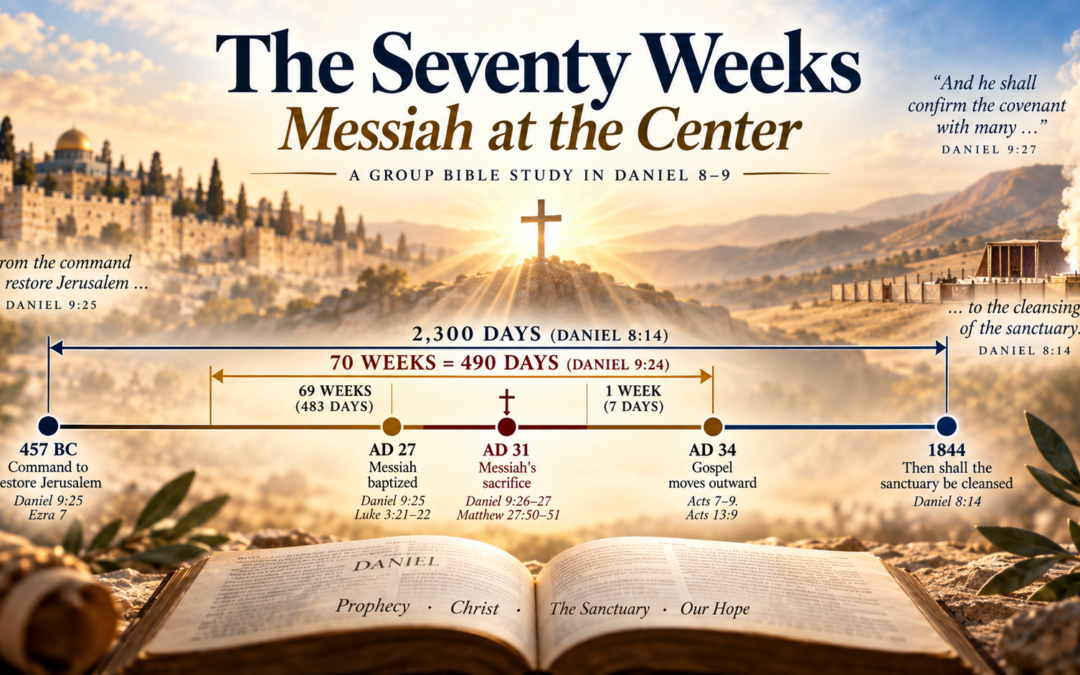
Messiah at the Center - In Song
Prophecy can easily become a study of dates, kingdoms, symbols, and calculations. Those things matter, and Scripture gives them for a reason. But the seventy-week prophecy of Daniel is ultimately much more than a timeline. When the vision is followed carefully, it leads directly to Jesus Christ.
Daniel was living in exile, carrying the burden of a ruined Jerusalem and a desolate sanctuary. He had been shown a vision that reached far beyond his own lifetime—a conflict involving truth, God's people, the Prince, and the sanctuary. Heaven itself raised the question, “How long shall be the vision?” (Daniel 8:13). The answer introduced the 2,300 days, yet Daniel did not fully understand what he had seen.
He searched the Scriptures. He prayed. He humbled himself before God. Then Gabriel returned and told him to consider the vision. The seventy weeks were opened before him, and the prophecy began moving toward one unmistakable destination:
“Messiah the Prince” (Daniel 9:25).
That is the heart of this study.
The seventy weeks bring us to Christ's anointing, His ministry, and the moment when “Messiah [would] be cut off, but not for himself” (Daniel 9:26). The earthly sacrifices find their meaning in the Lamb of God. The torn veil points beyond the earthly sanctuary. The story then follows the risen Christ into heaven, where Hebrews identifies Him as our High Priest and minister of “the true tabernacle, which the Lord pitched, and not man” (Hebrews 8:2).
Before beginning the written study, we invite you to listen to “Messiah at the Center.” The song is not intended to replace the study or interpret Scripture for you. It is a musical introduction to the biblical story you are about to follow—from Habakkuk's call to watch humbly for God's appointed time, through Daniel's vision and the seventy weeks, to the cross, the heavenly sanctuary, and the faithful people of God who are called to live by faith.
As you listen, keep one thought in mind:
The prophecy is important because of where it leads. It leads us to Jesus.
Then open the Word and test everything for yourself.
The larger question: “Unto two thousand and three hundred days; then shall the sanctuary be cleansed.” - Daniel 8:14
This study uses the King James Version throughout. Scripture is printed in full whenever a verse is quoted. Shorter biblical phrases used in the narrative are always identified by reference so that the reader can return to the surrounding context.
Purpose of This Study
The seventy-week prophecy is not an isolated calculation. It grows naturally out of Daniel 8, where Daniel is shown a conflict involving God's truth, His people, the Prince, and the sanctuary. Heaven asks how long the trampling described in the vision will continue, and Daniel is given the 2,300-day prophecy.
Daniel does not understand everything he has seen. In Daniel 9 the same Gabriel returns to give him understanding and immediately introduces the seventy weeks. That prophecy gives a historical starting point and leads directly to “Messiah the Prince” (Daniel 9:25).
For this study we will stop short of fully explaining the cleansing of the sanctuary. Our purpose is to follow the Word far enough to see whether the seventy-week prophecy leads to Jesus Christ, whether the earthly sanctuary points beyond itself, and how Revelation connects the final prophetic conflict with a people who keep the commandments of God and have the testimony of Jesus Christ.
Roadmap
The study follows one continuous line, while allowing enough room to understand the passages in their setting:
Daniel's situation → Daniel 8 → “How long?” → 2,300 days → Daniel does not understand → Daniel 9 prayer
Gabriel returns → 70 weeks → day/year → decree → Messiah → baptism/anointing → middle of week → cross
remaining 3½ years → Stephen → Saul/Paul → gospel outward → Hebrews → heavenly sanctuary
Revelation → commandments of God → testimony of Jesus → spirit of prophecy → judgment-hour gospel → Daniel 8:14 still before us
TOGGLE TO OPEN: Part One - The Vision And Its Historical Anchor
1. How Should We Study the Word?
Before interpreting prophecy, Scripture should establish how Scripture is to be studied. We do not want to begin with a denominational conclusion and then search for verses to support it. The Word itself should set the method.
Isaiah 28:9-10 - KJV
9 Whom shall he teach knowledge? and whom shall he make to understand doctrine? them that are weaned from the milk, and drawn from the breasts.
10 For precept must be upon precept, precept upon precept; line upon line, line upon line; here a little, and there a little:
Acts 17:11 - KJV
11 These were more noble than those in Thessalonica, in that they received the word with all readiness of mind, and searched the scriptures daily, whether those things were so.
John 16:13 - KJV
13 Howbeit when he, the Spirit of truth, is come, he will guide you into all truth: for he shall not speak of himself; but whatsoever he shall hear, that shall he speak: and he will shew you things to come.
1 Corinthians 2:13 - KJV
13 Which things also we speak, not in the words which man's wisdom teacheth, but which the Holy Ghost teacheth; comparing spiritual things with spiritual.
Our method will therefore be simple: read the Word, compare Scripture with Scripture, ask the Holy Spirit for understanding, and test every conclusion by what is written.
Group Questions
1.1 How does Isaiah describe the way understanding is built from Scripture?
1.2 What did the Bereans do when they heard teaching, and who did Jesus say would guide His people into truth?
2. Daniel Sees a Conflict Much Larger Than Himself
Daniel is an exile. Jerusalem has been conquered, and the sanctuary he knew lies desolate. Yet Daniel 8 carries him into something much larger than the immediate condition of Jerusalem. He sees an opposing power, God's truth attacked, the Prince opposed, God's people oppressed, and the sanctuary itself drawn into the conflict.
Daniel 8:11-14 - KJV
11 Yea, he magnified himself even to the prince of the host, and by him the daily sacrifice was taken away, and the place of his sanctuary was cast down.
12 And an host was given him against the daily sacrifice by reason of transgression, and it cast down the truth to the ground; and it practised, and prospered.
13 Then I heard one saint speaking, and another saint said unto that certain saint which spake, How long shall be the vision concerning the daily sacrifice, and the transgression of desolation, to give both the sanctuary and the host to be trodden under foot?
14 And he said unto me, Unto two thousand and three hundred days; then shall the sanctuary be cleansed.
The 2,300 days do not appear as a number dropped into the chapter without context. Truth is cast to the ground (Daniel 8:12), the sanctuary and the host are trodden underfoot (Daniel 8:13), and heaven asks, “How long shall be the vision...?” (Daniel 8:13). The answer is given in Daniel 8:14.
Revelation later identifies the adversary in this larger conflict and shows that accusation, Christ, and God's people are all involved.
Revelation 12:9-11 - KJV
9 And the great dragon was cast out, that old serpent, called the Devil, and Satan, which deceiveth the whole world: he was cast out into the earth, and his angels were cast out with him.
10 And I heard a loud voice saying in heaven, Now is come salvation, and strength, and the kingdom of our God, and the power of his Christ: for the accuser of our brethren is cast down, which accused them before our God day and night.
11 And they overcame him by the blood of the Lamb, and by the word of their testimony; and they loved not their lives unto the death.
Group Questions
2.1 What is being attacked or trodden down in Daniel 8:11-13?
2.2 What question does heaven ask, and what answer is given in Daniel 8:14?
2.3 How does Revelation 12 enlarge the conflict beyond earthly kingdoms?
3. Daniel's Earthly Sanctuary - and a Vision Reaching Much Farther
Daniel's immediate understanding of a sanctuary would naturally have included Jerusalem's temple. His own prayer makes that unmistakable.
Daniel 9:17 - KJV
17 Now therefore, O our God, hear the prayer of thy servant, and his supplications, and cause thy face to shine upon thy sanctuary that is desolate, for the Lord's sake.
The earthly sanctuary mattered deeply to Daniel. Yet the vision of Daniel 8 cannot end merely with the rebuilding of Jerusalem's temple, because Gabriel tells Daniel something remarkable about its reach.
Daniel 8:15-17 - KJV
15 And it came to pass, when I, even I Daniel, had seen the vision, and sought for the meaning, then, behold, there stood before me as the appearance of a man.
16 And I heard a man's voice between the banks of Ulai, which called, and said, Gabriel, make this man to understand the vision.
17 So he came near where I stood: and when he came, I was afraid, and fell upon my face: but he said unto me, Understand, O son of man: for at the time of the end shall be the vision.
Daniel is living with the ruin of an earthly sanctuary, yet Gabriel says the vision reaches “the time of the end” (Daniel 8:17). That leaves an important question before us: is the sanctuary at the conclusion of this prophecy ultimately greater than the earthly sanctuary Daniel knew?
Group Questions
3.1 What sanctuary is Daniel explicitly praying about in Daniel 9:17?
3.2 How far does Gabriel say the Daniel 8 vision reaches?
4. Daniel Does Not Yet Understand
Gabriel begins explaining the vision. Daniel is told plainly that the ram represents Media and Persia and the goat represents Greece in Daniel 8:20-21. Scripture itself interprets the symbols. Yet the chapter closes with something still unresolved.
Daniel 8:26-27 - KJV
26 And the vision of the evening and the morning which was told is true: wherefore shut thou up the vision; for it shall be for many days.
27 And I Daniel fainted, and was sick certain days; afterward I rose up, and did the king's business; and I was astonished at the vision, but none understood it.
Gabriel had been commanded, “Gabriel, make this man to understand the vision” (Daniel 8:16), yet Daniel ends the chapter saying, “I was astonished at the vision, but none understood it” (Daniel 8:27). The narrative itself tells us that there is unfinished business.
Group Questions
4.1 What had Gabriel been commanded to do in Daniel 8:16?
4.2 How does Daniel describe his understanding at the end of the chapter?
5. Daniel Goes Back to the Word
Daniel's response to the unresolved vision is not to invent an explanation. He goes back to the written Word and studies the prophecy already given through Jeremiah.
Daniel 9:1-2 - KJV
1 In the first year of Darius the son of Ahasuerus, of the seed of the Medes, which was made king over the realm of the Chaldeans;
2 In the first year of his reign I Daniel understood by books the number of the years, whereof the word of the LORD came to Jeremiah the prophet, that he would accomplish seventy years in the desolations of Jerusalem.
Daniel turns from study to prayer, and his prayer shows exactly what is weighing upon him.
Daniel 9:16-19 - KJV
16 O Lord, according to all thy righteousness, I beseech thee, let thine anger and thy fury be turned away from thy city Jerusalem, thy holy mountain: because for our sins, and for the iniquities of our fathers, Jerusalem and thy people are become a reproach to all that are about us.
17 Now therefore, O our God, hear the prayer of thy servant, and his supplications, and cause thy face to shine upon thy sanctuary that is desolate, for the Lord's sake.
18 O my God, incline thine ear, and hear; open thine eyes, and behold our desolations, and the city which is called by thy name: for we do not present our supplications before thee for our righteousnesses, but for thy great mercies.
19 O Lord, hear; O Lord, forgive; O Lord, hearken and do; defer not, for thine own sake, O my God: for thy city and thy people are called by thy name.
Daniel is not approaching prophecy as a detached mathematician. He is pleading for God's city, God's people, God's sanctuary, and God's name. While he is still praying, heaven responds.
Group Questions
5.1 What did Daniel do when he wanted to understand the times concerning Jerusalem?
5.2 What four concerns repeatedly appear in Daniel's prayer?
6. The Same Gabriel Returns
Daniel 9:20-24 - KJV
20 And whiles I was speaking, and praying, and confessing my sin and the sin of my people Israel, and presenting my supplication before the LORD my God for the holy mountain of my God;
21 Yea, whiles I was speaking in prayer, even the man Gabriel, whom I had seen in the vision at the beginning, being caused to fly swiftly, touched me about the time of the evening oblation.
22 And he informed me, and talked with me, and said, O Daniel, I am now come forth to give thee skill and understanding.
23 At the beginning of thy supplications the commandment came forth, and I am come to shew thee; for thou art greatly beloved: therefore understand the matter, and consider the vision.
24 Seventy weeks are determined upon thy people and upon thy holy city, to finish the transgression, and to make an end of sins, and to make reconciliation for iniquity, and to bring in everlasting righteousness, and to seal up the vision and prophecy, and to anoint the most Holy.
The sequence is difficult to miss. The same Gabriel returns (Daniel 9:21), says that he has come “to give thee skill and understanding” (Daniel 9:22), and directs Daniel to “consider the vision” (Daniel 9:23). He then immediately introduces the seventy weeks.
Before calculating anything, notice what Daniel 9:24 says those weeks concern: making an end of sins, making reconciliation for iniquity, bringing in everlasting righteousness, sealing the vision and prophecy, and anointing the most Holy. The prophecy is already moving beyond a simple rebuilding project.
Group Questions
6.1 Who returns to Daniel, and what does he say he has come to give?
6.2 What does Gabriel tell Daniel to consider immediately before introducing the seventy weeks?
6.3 What great spiritual accomplishments are named in Daniel 9:24?
7. What Does “Determined” Mean?
Daniel 9:24 uses the Hebrew word נֶחְתַּךְ (neḥtak), translated “determined” in the KJV. The underlying idea carries the sense of something determined, apportioned, divided, or set apart.
We should not make the Hebrew word carry more weight than it can bear. The word by itself does not say, “cut off from the 2,300 days.” The context must answer what the seventy weeks relate to.
The context is compelling: Daniel 8 introduced the unresolved 2,300-day period; Gabriel had been commanded to give understanding; Daniel ended without understanding; Daniel 9 brings the same Gabriel back to give understanding and again directs Daniel to “consider the vision” (Daniel 9:23). Then Gabriel immediately introduces the seventy weeks. The connection rests upon the flow of Daniel 8 and 9, not on one Hebrew word alone.
Group Questions
7.1 Why should the connection between the seventy weeks and Daniel 8 rest on context rather than on the Hebrew word neḥtak alone?
8. Let the Bible Establish Prophetic Time
If the seventy weeks are prophetic time, how should they be understood? Rather than beginning with a denominational rule, we should ask whether Scripture itself ever uses a day to represent a year in prophetic symbolism.
Numbers 14:34 - KJV
34 After the number of the days in which ye searched the land, even forty days, each day for a year, shall ye bear your iniquities, even forty years, and ye shall know my breach of promise.
Ezekiel 4:6 - KJV
6 And when thou hast accomplished them, lie again on thy right side, and thou shalt bear the iniquity of the house of Judah forty days: I have appointed thee each day for a year.
The principle comes from the Word itself: “each day for a year” (Numbers 14:34), and “I have appointed thee each day for a year” (Ezekiel 4:6). Seventy weeks contain 490 days. Applied prophetically, the seventy weeks represent 490 years. The first sixty-nine weeks contain 483 prophetic years.
Group Questions
8.1 What day-for-year language does Scripture use in Numbers 14:34 and Ezekiel 4:6?
8.2 How many prophetic days, and therefore years in this application, are contained in seventy weeks?
8.3 How many years are contained in sixty-nine prophetic weeks?
9. The Prophecy Gives Its Historical Starting Point
Daniel 9:25 - KJV
25 Know therefore and understand, that from the going forth of the commandment to restore and to build Jerusalem unto the Messiah the Prince shall be seven weeks, and threescore and two weeks: the street shall be built again, and the wall, even in troublous times.
We are not free to choose whatever beginning produces a desirable answer. The Word gives the event: “the going forth of the commandment to restore and to build Jerusalem” (Daniel 9:25). It also gives the destination: “Messiah the Prince” (Daniel 9:25).
Group Questions
9.1 What event does Daniel 9:25 give as the starting point?
9.2 To whom does Gabriel say the sixty-nine weeks will lead?
10. Which Persian Command?
Scripture records several Persian actions concerning Jerusalem. For comparison, read Ezra 1:1-4, Ezra 6:1-12, Ezra 7:11-26, and Nehemiah 2:1-8. Cyrus authorized the Jews to return and rebuild the house of God. Darius later confirmed the earlier decree. Nehemiah later received specific permission and resources connected with Jerusalem's walls and gates.
The commission given to Ezra in the seventh year of Artaxerxes is broader. It includes not only temple support but recognized authority for Jerusalem's religious and civil administration.
Ezra 7:7-9 - KJV
7 And there went up some of the children of Israel, and of the priests, and the Levites, and the singers, and the porters, and the Nethinims, unto Jerusalem, in the seventh year of Artaxerxes the king.
8 And he came to Jerusalem in the fifth month, which was in the seventh year of the king.
9 For upon the first day of the first month began he to go up from Babylon, and on the first day of the fifth month came he to Jerusalem, according to the good hand of his God upon him.
Ezra 7:25-26 - KJV
25 And thou, Ezra, after the wisdom of thy God, that is in thine hand, set magistrates and judges, which may judge all the people that are beyond the river, all such as know the laws of thy God; and teach ye them that know them not.
26 And whosoever will not do the law of thy God, and the law of the king, let judgment be executed speedily upon him, whether it be unto death, or to banishment, or to confiscation of goods, or to imprisonment.
This is considerably more than permission to repair a building. Judges and magistrates are appointed, law is administered, and judicial authority is recognized. That fits naturally with Daniel's language concerning the restoration of Jerusalem.
Historical note: Artaxerxes I is generally dated to 465/464-424/423 BC. Ezra repeatedly places his mission in the king's seventh year (Ezra 7:7-8). Historical chronologies commonly place that year in 458 BC; the historicist calculation used in this study follows an autumn-to-autumn Jewish reckoning in which Ezra's first-to-fifth-month journey falls in 457 BC. The historical evidence helps us identify the real-world anchor named by Scripture; it does not interpret the prophecy for us.
Group Questions
10.1 What year of Artaxerxes does Ezra repeatedly identify?
10.2 What authority in Ezra 7:25-26 shows that the commission involved more than rebuilding the temple?
TOGGLE TO OPEN: Part Two - Messiah At The Center
11. Sixty-Nine Weeks Lead to Messiah
Daniel 9:25 gives seven weeks and sixty-two weeks, a total of sixty-nine weeks. Sixty-nine prophetic weeks contain 483 prophetic years. Beginning with 457 BC and remembering that the calendar passes directly from 1 BC to AD 1 without a year zero, the prophetic calculation reaches AD 27.
The remarkable thing, however, is not the arithmetic. It is what Gabriel said would be found at the end of the sixty-nine weeks: “Messiah the Prince” (Daniel 9:25). Messiah means Anointed One.
A Jewish Tradition Concerning Daniel and the Time of Messiah
Later rabbinic tradition is worth noting here - not as an authority over Scripture, but because it shows that Daniel's chronology was understood within Jewish tradition to contain unusually significant information concerning Messiah and the time of the end. The Babylonian Talmud, Megillah 3a, preserves a tradition that Jonathan ben Uzziel was prevented from producing an Aramaic translation of the Writings because it contained a revelation of the end, when Messiah would arrive; the discussion identifies Daniel as the book in which that end is cryptically foretold. Sanhedrin 97b also warns against calculating the end, explaining that failed calculations could cause people to conclude that Messiah would never come.
These traditions should not be exaggerated. They do not establish a general Jewish prohibition against reading Daniel 9, nor do they say that Daniel was suppressed because it proved Jesus was Messiah. Jewish interpreters continued to study Daniel. Rashi, for example, explicitly treated the seventy weeks as 490 years while applying the chronology differently. The value of this tradition here is simply that Daniel's timetable was recognized as messianically significant. Tradition, Jewish or Christian, still cannot settle the prophecy. The Word must do that.
So we return to Scripture and ask the question that matters: if we begin where Daniel tells us to begin and follow the prophetic time forward, whom does the Word identify as the Anointed One?
Group Questions
11.1 What title does Daniel 9:25 place at the end of the sixty-nine weeks?
11.2 What does the title “Messiah” mean?
12. Jesus Is Anointed
Luke 3:21-22 - KJV
21 Now when all the people were baptized, it came to pass, that Jesus also being baptized, and praying, the heaven was opened,
22 And the Holy Ghost descended in a bodily shape like a dove upon him, and a voice came from heaven, which said, Thou art my beloved Son; in thee I am well pleased.
Peter later described what happened at the beginning of Jesus' ministry.
Acts 10:37-38 - KJV
37 That word, I say, ye know, which was published throughout all Judaea, and began from Galilee, after the baptism which John preached;
38 How God anointed Jesus of Nazareth with the Holy Ghost and with power: who went about doing good, and healing all that were oppressed of the devil; for God was with him.
Daniel had said the sixty-nine weeks would reach “Messiah the Prince” (Daniel 9:25). Acts says that “God anointed Jesus of Nazareth with the Holy Ghost and with power” (Acts 10:38). The prophetic timeline has brought us directly to Jesus Christ.
Group Questions
12.1 What happened to Jesus at His baptism?
12.2 What word does Acts 10:38 use to describe what God did to Jesus?
13. One Prophetic Week Remains
Seventy weeks equal 490 years. Sixty-nine weeks - 483 years - have brought us to Messiah, which means that one prophetic week remains. One prophetic week equals seven prophetic years. The seventieth week begins with Jesus, and the prophecy tells us to watch carefully what happens in its middle.
Group Questions
13.1 After sixty-nine of the seventy weeks have passed, how much prophetic time remains?
14. Messiah Is Cut Off - the Type Meets the Reality
Daniel 9:26-27 - KJV
26 And after threescore and two weeks shall Messiah be cut off, but not for himself: and the people of the prince that shall come shall destroy the city and the sanctuary; and the end thereof shall be with a flood, and unto the end of the war desolations are determined.
27 And he shall confirm the covenant with many for one week: and in the midst of the week he shall cause the sacrifice and the oblation to cease, and for the overspreading of abominations he shall make it desolate, even until the consummation, and that determined shall be poured upon the desolate.
Messiah does not merely appear; He is “cut off, but not for himself” (Daniel 9:26). Daniel also says that “in the midst of the week he shall cause the sacrifice and the oblation to cease” (Daniel 9:27). Half of a seven-year period is three and one-half years. On the prophetic reckoning used in this study, the middle of the final week falls in AD 31.
Chronology note: Daniel does not print the calendar date AD 31 in the text. That date follows from the 457 BC starting point and the prophetic calculation used here. The central biblical question is what happens to Messiah in the middle of the week.
John 1:29 - KJV
29 The next day John seeth Jesus coming unto him, and saith, Behold the Lamb of God, which taketh away the sin of the world.
Matthew 27:50-51 - KJV
50 Jesus, when he had cried again with a loud voice, yielded up the ghost.
51 And, behold, the veil of the temple was rent in twain from the top to the bottom; and the earth did quake, and the rocks rent;
Hebrews 10:4 - KJV
4 For it is not possible that the blood of bulls and of goats should take away sins.
Hebrews 10:10 - KJV
10 By the which will we are sanctified through the offering of the body of Jesus Christ once for all.
When these passages are placed together, the meaning becomes much clearer. Daniel foretold that Messiah would be cut off (Daniel 9:26). John identified Jesus as “the Lamb of God” (John 1:29). Daniel foretold that sacrifice and oblation would cease in the middle of the final week (Daniel 9:27). When Jesus died, the temple veil was torn (Matthew 27:50-51), and Hebrews explains that animal blood could never actually remove sin, while Christ offered Himself “once for all” (Hebrews 10:10). The earthly service had been teaching Israel beforehand about the sacrifice finally accomplished in Christ.
Group Questions
14.1 What does Daniel say will happen to Messiah?
14.2 What does Daniel say will happen to sacrifice and oblation in the middle of the week?
14.3 How do John 1:29, Matthew 27:50-51, and Hebrews 10:4,10 explain why the sacrificial type reaches its fulfillment in Christ?
15. The Cross and the Larger Conflict
Jesus Himself described His approaching death in terms that reach beyond personal salvation alone.
John 12:31-32 - KJV
31 Now is the judgment of this world: now shall the prince of this world be cast out.
32 And I, if I be lifted up from the earth, will draw all men unto me.
Romans 3:25-26 - KJV
25 Whom God hath set forth to be a propitiation through faith in his blood, to declare his righteousness for the remission of sins that are past, through the forbearance of God;
26 To declare, I say, at this time his righteousness: that he might be just, and the justifier of him which believeth in Jesus.
The conflict we first saw in Daniel 8 is therefore not disconnected from the cross. At Calvary the Lamb dies for sinners, Jesus declares judgment upon “the prince of this world” (John 12:31), and God is revealed as both “just, and the justifier” (Romans 3:26). The sanctuary story belongs within a much larger biblical conflict over sin, truth, accusation, salvation, and the character and government of God.
Group Questions
15.1 How does Jesus describe the cross in relation to “the prince of this world”?
15.2 What does Romans 3:25-26 say the work of Christ declares about God?
16. The Cross Is in the Middle of the Week
Christ's death occurs in the middle, not at the end, of the seventieth week. Approximately three and one-half prophetic years therefore remain. Gabriel had said that the seventy weeks were “determined upon thy people and upon thy holy city” (Daniel 9:24). The special covenant appeal to Daniel's people did not suddenly end when Jesus died.
Acts 3:25-26 - KJV
25 Ye are the children of the prophets, and of the covenant which God made with our fathers, saying unto Abraham, And in thy seed shall all the kindreds of the earth be blessed.
26 Unto you first God, having raised up his Son Jesus, sent him to bless you, in turning away every one of you from his iniquities.
The words “Unto you first” (Acts 3:26) are important. Even after the cross, the covenant appeal continues.
Group Questions
16.1 What does Peter's phrase “Unto you first” show about the gospel appeal after the cross?
17. Stephen, Saul, Paul, and the Gospel Moving Outward
Beginning from 457 BC, the full 490-year period reaches approximately AD 34 on this prophetic reckoning. Acts does not attach the date AD 34 to a verse concerning Stephen, so we should not pretend that it does. What Acts does give us is a striking transition in the narrative.
Acts 7:51-56 - KJV
51 Ye stiffnecked and uncircumcised in heart and ears, ye do always resist the Holy Ghost: as your fathers did, so do ye.
52 Which of the prophets have not your fathers persecuted? and they have slain them which shewed before of the coming of the Just One; of whom ye have been now the betrayers and murderers:
53 Who have received the law by the disposition of angels, and have not kept it.
54 When they heard these things, they were cut to the heart, and they gnashed on him with their teeth.
55 But he, being full of the Holy Ghost, looked up stedfastly into heaven, and saw the glory of God, and Jesus standing on the right hand of God,
56 And said, Behold, I see the heavens opened, and the Son of man standing on the right hand of God.
Stephen sees Jesus standing at the right hand of God (Acts 7:55-56). Stephen is then killed, and the persecution that follows scatters the believers beyond Jerusalem.
Acts 8:1 - KJV
1 And Saul was consenting unto his death. And at that time there was a great persecution against the church which was at Jerusalem; and they were all scattered abroad throughout the regions of Judaea and Samaria, except the apostles.
Acts 8:4 - KJV
4 Therefore they that were scattered abroad went every where preaching the word.
At precisely this point another man comes into view - Saul. For someone less familiar with Acts, Scripture itself makes clear that this is the same man later known as Paul.
Acts 13:9 - KJV
9 Then Saul, (who also is called Paul,) filled with the Holy Ghost, set his eyes on him,
When Saul approaches Damascus, the One who personally confronts him is Jesus.
Acts 9:3-6 - KJV
3 And as he journeyed, he came near Damascus: and suddenly there shined round about him a light from heaven:
4 And he fell to the earth, and heard a voice saying unto him, Saul, Saul, why persecutest thou me?
5 And he said, Who art thou, Lord? And the Lord said, I am Jesus whom thou persecutest: it is hard for thee to kick against the pricks.
6 And he trembling and astonished said, Lord, what wilt thou have me to do? And the Lord said unto him, Arise, and go into the city, and it shall be told thee what thou must do.
Acts 9:15 - KJV
15 But the Lord said unto him, Go thy way: for he is a chosen vessel unto me, to bear my name before the Gentiles, and kings, and the children of Israel:
The gospel does not cease to be available to Jewish people - Paul himself is Jewish, and his ministry continually reaches out to Jews. But the period “determined upon thy people and upon thy holy city” (Daniel 9:24) has reached its conclusion in this prophetic reckoning, and Acts shows the mission visibly widening beyond Jerusalem and Judea to the nations.
Group Questions
17.1 Whom does Stephen see in heaven?
17.2 What happens to the believers after Stephen's death?
17.3 How does Scripture identify Saul with Paul?
17.4 What mission does Jesus give Saul/Paul?
18. Stand Back and Look at the Seventieth Week
It is helpful to step back and look at the final week as a whole. The prophecy has not been moving from date to date merely for the sake of a chart. Each major point has brought us again to Jesus.
AD 27 - Messiah the Prince: Jesus is baptized and anointed with the Holy Ghost (Luke 3:21-22; Acts 10:38)
3½ years later - Messiah is cut off: the Lamb of God dies and the sacrificial type meets its fulfillment (Daniel 9:26-27; John 1:29; Matthew 27:50-51)
the final 3½ years - the covenant appeal continues “unto you first” (Acts 3:25-26)
approximately AD 34 - Stephen's witness, the scattering beyond Jerusalem, Saul/Paul enters the story, and Jesus commissions him toward the Gentiles (Acts 7-9)
The arithmetic matters because it gives structure to the prophecy, but the arithmetic leads us to a Person: Messiah the Prince.
Group Questions
18.1 Who stands at every major point of the seventieth week?
18.2 What does the fulfillment of the seventy weeks give us reason to do with the larger Daniel 8 vision?
TOGGLE TO OPEN: Timeline Overview: The 70 Weeks Within the 2,300-Day Prophecy
Your content goes here. Edit or remove this text inline or in the module Content settings. You can also style every aspect of this content in the module Design settings and even apply custom CSS to this text in the module Advanced settings.
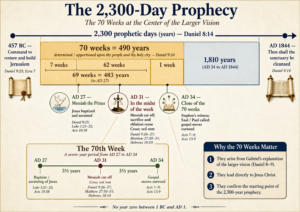
The 70-week prophecy leads to Messiah and provides the Christ-centered anchor for following the larger 2,300-day vision.
With the seventy weeks established, we can now return to Daniel 8:14 and ask what Scripture means by the cleansing of the sanctuary. That question moves us from the earthly sanctuary Daniel knew toward the heavenly sanctuary in which Hebrews says Christ now ministers.
TOGGLE TO OPEN: Part Three - From The Earthly Sanctuary To The Final Prophetic Message
19. Return to the Larger Vision
Daniel 8:13-14 - KJV
13 Then I heard one saint speaking, and another saint said unto that certain saint which spake, How long shall be the vision concerning the daily sacrifice, and the transgression of desolation, to give both the sanctuary and the host to be trodden under foot?
14 And he said unto me, Unto two thousand and three hundred days; then shall the sanctuary be cleansed.
The seventy weeks did not appear in isolation. Daniel received the 2,300-day vision; Gabriel was commanded to give Daniel understanding (Daniel 8:16); Daniel ended without understanding it (Daniel 8:27); Daniel studied the Word and prayed concerning Jerusalem and the desolate sanctuary (Daniel 9:1-19); the same Gabriel returned (Daniel 9:21); Gabriel said he had come to give understanding (Daniel 9:22); Gabriel told Daniel to “consider the vision” (Daniel 9:23); and then the seventy weeks were introduced (Daniel 9:24).
Those seventy weeks gave us a historical starting point and led directly to Messiah. Daniel 9:24 had also said that these events would “seal up the vision and prophecy.” Without forcing that phrase beyond what the text can bear, the seventy weeks plainly function as a powerful Christ-centered confirmation of the larger prophetic framework. If the prophecy can carry us to Messiah, we have good reason to continue following the larger vision.
Group Questions
19.1 What sequence in Daniel 8 and 9 connects Gabriel's return with the seventy weeks?
19.2 Why do the fulfilled seventy weeks give confidence to continue studying the larger 2,300-day vision?
20. The Sanctuary Story Does Not End on Earth
Daniel's immediate concern involved the earthly sanctuary, but the New Testament tells us that the earthly sanctuary was not the ultimate reality. Jesus has a sanctuary ministry after His death, resurrection, and ascension.
Hebrews 8:1-2 - KJV
1 Now of the things which we have spoken this is the sum: We have such an high priest, who is set on the right hand of the throne of the Majesty in the heavens;
2 A minister of the sanctuary, and of the true tabernacle, which the Lord pitched, and not man.
Hebrews 8:5 - KJV
5 Who serve unto the example and shadow of heavenly things, as Moses was admonished of God when he was about to make the tabernacle: for, See, saith he, that thou make all things according to the pattern shewed to thee in the mount.
Hebrews 9:23-24 - KJV
23 It was therefore necessary that the patterns of things in the heavens should be purified with these; but the heavenly things themselves with better sacrifices than these.
24 For Christ is not entered into the holy places made with hands, which are the figures of the true; but into heaven itself, now to appear in the presence of God for us:
The earthly sanctuary was “the example and shadow of heavenly things” (Hebrews 8:5), and the earthly holy places were “the figures of the true” (Hebrews 9:24). Jesus entered “into heaven itself, now to appear in the presence of God for us” (Hebrews 9:24). The sanctuary story therefore did not end when the earthly sacrifice met its fulfillment at the cross. The Word follows Jesus into heaven and identifies Him there as our High Priest.
Group Questions
20.1 Where does Hebrews place our High Priest?
20.2 What relationship does Hebrews describe between the earthly sanctuary and heavenly things?
20.3 Where did Christ enter on our behalf?
21. A Prophetic People in the Final Conflict
Once Scripture has carried us from Daniel's prophecy to Messiah and from the earthly sanctuary to Christ's ministry in heaven, Revelation shows us a people living in the closing conflict. The same dragon identified earlier in Revelation 12 turns his anger toward the remnant.
Revelation 12:17 - KJV
17 And the dragon was wroth with the woman, and went to make war with the remnant of her seed, which keep the commandments of God, and have the testimony of Jesus Christ.
Revelation 12:17 does not leave the characteristics of this people vague. They keep the commandments of God, and they have the testimony of Jesus Christ. Revelation later tells us what the testimony of Jesus is.
Revelation 19:10 - KJV
10 And I fell at his feet to worship him. And he said unto me, See thou do it not: I am thy fellowservant, and of thy brethren that have the testimony of Jesus: worship God: for the testimony of Jesus is the spirit of prophecy.
The definition comes from Scripture itself: “the testimony of Jesus is the spirit of prophecy” (Revelation 19:10). At this point we do not need to identify any modern individual or organization. The Word has simply established that, in the final conflict, Revelation describes a people who keep God's commandments and possess the testimony of Jesus, which Scripture calls the spirit of prophecy.
Group Questions
21.1 What two characteristics identify the remnant in Revelation 12:17?
21.2 How does Revelation 19:10 define the testimony of Jesus?
21.3 Who should define the meaning of “the testimony of Jesus” for this study?
22. The Everlasting Gospel, the Judgment Hour, and the Faith of Jesus
Revelation 14 places a worldwide gospel proclamation in the setting of judgment and worship. This brings together themes that have already appeared in Daniel: heavenly judgment, prophetic time, worship, and the conflict over allegiance to God.
Revelation 14:6-7 - KJV
6 And I saw another angel fly in the midst of heaven, having the everlasting gospel to preach unto them that dwell on the earth, and to every nation, and kindred, and tongue, and people,
7 Saying with a loud voice, Fear God, and give glory to him; for the hour of his judgment is come: and worship him that made heaven, and earth, and the sea, and the fountains of waters.
Later in the same chapter, Revelation again describes the saints in language that joins obedience to God with faith in Jesus.
Revelation 14:12 - KJV
12 Here is the patience of the saints: here are they that keep the commandments of God, and the faith of Jesus.
This keeps the final prophetic message centered where the seventy-week prophecy has been centered all along. The people of God are not described merely as people with correct information. They keep the commandments of God, they have the testimony of Jesus (Revelation 12:17), that testimony is called the spirit of prophecy (Revelation 19:10), and they possess “the faith of Jesus” (Revelation 14:12). The everlasting gospel itself remains at the heart of the final message (Revelation 14:6).
Group Questions
22.1 To whom is the everlasting gospel preached in Revelation 14:6?
22.2 What announcement and call to worship accompany that gospel in Revelation 14:7?
22.3 How does Revelation 14:12 describe the saints?
Where the Word Has Brought Us
We began with Daniel in exile and a sanctuary lying desolate. Daniel 8 then opened a much larger conflict in which truth is cast down, the Prince is opposed, God's people are trodden underfoot, and heaven asks, “How long shall be the vision...?” (Daniel 8:13). God answers, “Unto two thousand and three hundred days; then shall the sanctuary be cleansed” (Daniel 8:14).
Gabriel returned to give understanding, and the seventy weeks led us to Jesus. The sacrificial service led us to Jesus. Stephen looked into heaven and saw Jesus. Saul met Jesus and is later called Paul. Jesus commissioned him toward the Gentiles. Hebrews then tells us where the risen Christ ministers: “the sanctuary...the true tabernacle, which the Lord pitched, and not man” (Hebrews 8:2). Revelation carries the conflict forward and describes a people who keep the commandments of God, have the testimony of Jesus, and live in the setting of the everlasting gospel and the judgment hour.
The movement of the study has therefore been from the earthly sanctuary, to the Lamb of God, to the cross, to the risen Christ, to our High Priest in the heavenly sanctuary, and finally to a prophetic people in the closing conflict. Yet one statement still waits for fuller study.
Daniel 8:14 - KJV
14 And he said unto me, Unto two thousand and three hundred days; then shall the sanctuary be cleansed.
The Question for the Next Study
We learned what sacrifice meant by studying the earthly sanctuary and then watching the type meet its fulfillment in Jesus. Could the earthly sanctuary's cleansing also be a type that helps us understand Daniel 8:14? And if Jesus is now ministering in “the true tabernacle, which the Lord pitched, and not man” (Hebrews 8:2), what is the cleansing of the sanctuary, and what is Jesus doing there?
A separate study can also take up another question raised by Revelation 19:10: if Scripture says “the testimony of Jesus is the spirit of prophecy,” how does the Bible tell us to test a claimed prophet? That question deserves its own careful study rather than being crowded into this one.
TOGGLE TO OPEN: Historical Referance and Answer Guide
Historical and Language Reference Notes
These references support only the historical and language notes in the study. They are not used as authorities for interpreting prophecy; the biblical argument is developed from Scripture.
Hebrew neḥtak: Daniel 9:24. The term is commonly discussed in lexicons and commentaries with senses such as determined, decreed, apportioned, or cut/set apart. Because it occurs only here in the Hebrew Bible, the Daniel 8-9 context must carry the interpretive connection.
Artaxerxes I: Encyclopaedia Iranica, “Artaxerxes I,” dates the reign to 465/464-424/423 BC and notes Ezra's mission in the seventh regnal year.
Persian chronology: Richard A. Parker and Waldo H. Dubberstein, Babylonian Chronology 626 B.C.-A.D. 75, is a standard technical reference for Babylonian and Persian regnal chronology.
Jewish tradition - Daniel: Babylonian Talmud, Megillah 3a, records the tradition that a translation of the Writings was withheld because it contained a revelation of the end when Messiah would arrive and specifically points to Daniel as containing the cryptic prediction.
Jewish tradition - calculations: Babylonian Talmud, Sanhedrin 97b, warns against calculating the end because failed calculations might cause people to conclude that Messiah would not come.
Rashi: Rashi on Daniel 9:24 explicitly interprets the seventy weeks as 490 years, while applying the period differently from the Christian interpretation.
ANSWER GUIDE
The answers below are intentionally brief. Each answer points back to Scripture so that the group can establish the answer from the Word itself rather than from the guide.
1.1 Understanding is built “precept upon precept” and “line upon line,” comparing one part of Scripture with another. Scripture: Isaiah 28:9-10; 1 Corinthians 2:13
1.2 The Bereans searched the Scriptures to test what they heard, and Jesus said the Spirit of truth would guide into all truth. Scripture: Acts 17:11; John 16:13
2.1 The Prince is opposed, truth is cast down, and the sanctuary and the host are trodden underfoot. Scripture: Daniel 8:11-13
2.2 Heaven asks how long the vision and trampling will continue; the answer is 2,300 days, after which the sanctuary shall be cleansed. Scripture: Daniel 8:13-14
2.3 Revelation identifies Satan as the dragon and accuser, shows Christ opposed, and shows God's people overcoming by the blood of the Lamb. Scripture: Revelation 12:9-11
3.1 Daniel is praying about God's sanctuary that is desolate in connection with Jerusalem. Scripture: Daniel 9:16-17
3.2 Gabriel says the vision reaches “the time of the end.” Scripture: Daniel 8:17
4.1 Gabriel was commanded to make Daniel understand the vision. Scripture: Daniel 8:16
4.2 Daniel says he was astonished at the vision and that none understood it. Scripture: Daniel 8:27
5.1 Daniel studied the written prophetic word already given through Jeremiah. Scripture: Daniel 9:1-2
5.2 His prayer repeatedly concerns God's people, Jerusalem/holy mountain, the desolate sanctuary, and God's name and mercy. Scripture: Daniel 9:16-19
6.1 Gabriel returns and says he has come to give Daniel skill and understanding. Scripture: Daniel 9:21-22
6.2 Gabriel tells Daniel to “consider the vision.” Scripture: Daniel 9:23
6.3 The seventy weeks concern finishing transgression, making an end of sins, reconciliation for iniquity, everlasting righteousness, sealing the vision and prophecy, and anointing the most Holy. Scripture: Daniel 9:24
7.1 Because Scripture connects the chapters by the same Gabriel, the unfinished vision, the promise of understanding, and the command to consider the vision before the seventy weeks are introduced. Scripture: Daniel 8:16,26-27; Daniel 9:21-24
8.1 Numbers says “each day for a year,” and Ezekiel says “I have appointed thee each day for a year.” Scripture: Numbers 14:34; Ezekiel 4:6
8.2 Seventy weeks contain 490 prophetic days; under the day-for-year application used here, 490 years. Scripture: Daniel 9:24; Numbers 14:34; Ezekiel 4:6
8.3 Sixty-nine weeks contain 483 prophetic days/years. Scripture: Daniel 9:25; Numbers 14:34; Ezekiel 4:6
9.1 The starting point is the going forth of the commandment to restore and to build Jerusalem. Scripture: Daniel 9:25
9.2 The sixty-nine weeks lead “unto the Messiah the Prince.” Scripture: Daniel 9:25
10.1 Ezra repeatedly identifies the seventh year of Artaxerxes. Scripture: Ezra 7:7-9
10.2 Ezra is authorized to set magistrates and judges and to administer law and judgment, showing civil and judicial restoration as well as temple support. Scripture: Ezra 7:25-26
11.1 The title is “Messiah the Prince.” Scripture: Daniel 9:25
11.2 Messiah is the Anointed One; the New Testament identifies Jesus as the One God anointed with the Holy Ghost and power. Scripture: Daniel 9:25; Acts 10:38
12.1 At Jesus' baptism the heaven opened, the Holy Ghost descended upon Him, and the Father declared Him His beloved Son. Scripture: Luke 3:21-22
12.2 Acts says God “anointed” Jesus of Nazareth with the Holy Ghost and with power. Scripture: Acts 10:38
13.1 One week remains, which is seven prophetic days/years in this application. Scripture: Daniel 9:24-27; Numbers 14:34; Ezekiel 4:6
14.1 Messiah is to be “cut off, but not for himself.” Scripture: Daniel 9:26
14.2 In the midst of the week sacrifice and oblation cease. Scripture: Daniel 9:27
14.3 Jesus is identified as the Lamb of God; at His death the temple veil is torn; Hebrews says animal blood cannot take away sins and Christ offered Himself once for all. Scripture: John 1:29; Matthew 27:50-51; Hebrews 10:4,10
15.1 Jesus says His lifting up is connected with the judgment of this world and the casting out of “the prince of this world.” Scripture: John 12:31-32
15.2 Christ's work declares God's righteousness and shows Him to be “just, and the justifier” of the believer in Jesus. Scripture: Romans 3:25-26
16.1 The risen Christ is still sent “unto you first,” showing the covenant appeal to Daniel's people continued after the cross. Scripture: Acts 3:25-26
17.1 Stephen sees the glory of God and Jesus standing at the right hand of God. Scripture: Acts 7:55-56
17.2 Persecution scatters the believers through Judaea and Samaria, and they go everywhere preaching the Word. Scripture: Acts 8:1,4
17.3 Acts explicitly says, “Saul, (who also is called Paul).” Scripture: Acts 13:9
17.4 Jesus calls Saul/Paul a chosen vessel to bear His name before the Gentiles, kings, and the children of Israel. Scripture: Acts 9:15
18.1 Jesus stands at every major point: Messiah/anointed One, the One cut off, the risen Christ seen by Stephen, and the Lord who calls and commissions Paul. Scripture: Daniel 9:25-27; Acts 10:38; Acts 7:55-56; Acts 9:5,15
18.2 The Christ-centered fulfillment gives reason to take the larger vision seriously and continue following the prophetic framework. Scripture: Daniel 8:14,16,26-27; Daniel 9:21-25
19.1 Gabriel is commanded to explain the vision; Daniel ends without understanding; the same Gabriel returns to give understanding, tells Daniel to consider the vision, and introduces the seventy weeks. Scripture: Daniel 8:16,26-27; Daniel 9:21-24
19.2 Because the connected seventy-week prophecy leads to Messiah and is fulfilled in Christ, it provides a strong biblical reason to continue studying the larger vision from which the discussion arose. Scripture: Daniel 9:24-27; Luke 3:21-22; Acts 10:38
20.1 Our High Priest is at the right hand of the Majesty in the heavens and ministers in the true sanctuary/tabernacle. Scripture: Hebrews 8:1-2
20.2 The earthly service is described as an “example and shadow of heavenly things” and its holy places as “figures of the true.” Scripture: Hebrews 8:5; Hebrews 9:23-24
20.3 Christ entered “into heaven itself, now to appear in the presence of God for us.” Scripture: Hebrews 9:24
21.1 The remnant keep the commandments of God and have the testimony of Jesus Christ. Scripture: Revelation 12:17
21.2 Scripture says, “the testimony of Jesus is the spirit of prophecy.” Scripture: Revelation 19:10
21.3 Scripture itself should define the expression; Revelation 19:10 supplies the definition. Scripture: Revelation 19:10; Acts 17:11
22.1 The everlasting gospel goes to every nation, kindred, tongue, and people. Scripture: Revelation 14:6
22.2 The message announces that the hour of God's judgment is come and calls the world to fear God, give Him glory, and worship the Creator. Scripture: Revelation 14:7
22.3 The saints are described as keeping the commandments of God and possessing the faith of Jesus. Scripture: Revelation 14:12